
Terrascope is a learning community where first-year MIT students collaborate to solve complex, real-world problems. “With each new class of first-year students, Terrascope explores a different global issue – and it’s the students who take command. [We] work in teams to develop solutions, drawing on diverse perspectives, interdisciplinary research, and a supportive Terrascope community” (Terrascope | About, 2025) This year, Terrascope’s focus is sustainable agriculture and food security in Puerto Rico. Read more about Terrascope here.
In September 2025, Terrascope 2029 began to research how to reimagine Puerto Rico’s food system. Our final goal was to draft a proposal that would promote food security, public health, resilience to natural disasters, and environmental sustainability, and to identify practical pathways toward enacting our proposed changes.
Our Problem Statement
Puerto Rico experiences high levels of food insecurity, stemming from repeated natural disasters, a lack of resiliency in the power grid and distribution systems, and insufficient food production on the island due to industrialization. Our task is to design a system that will reduce food insecurity and improve long-term resiliency against natural disasters in farms and surrounding infrastructure by reimagining Puerto Rico with a prolific agricultural production network, a stable and consistent way of preserving food, and improved access to food through resilient transportation infrastructure in order to promote self-sufficiency (i.e. food sovereignty).
What is Food Insecurity?
Food insecurity, as defined by the USDA, means that “at times during the year … households [are] uncertain of having or unable to acquire enough food to meet the needs of all their members because they [have] insufficient money or other resources for food.” (USDA, 2025)
Roughly 40% of Puerto Ricans are estimated to be food insecure (Ostolaza et. al, 2021). Read more about the food crisis in Puerto Rico here.
Over the past few months, we have worked to narrow the scope of our focus down to specific ways communities can deal with disaster-related insecurity in the short term. In the long term, we intend to propose a way to build up self sufficiency through local farming efforts and education initiatives. Read more about our process here.
This proposal is intended for local non-profit organizations, businesses, and municipalities which could potentially work together using these ideas to help alleviate food insecurity in Puerto Rico. Additional funding from the Puerto Rican government, such as through the Public-Private Partnerships Authority (P3A) is also proposed (more detail in Funding). We narrowed our scope to focus on distribution, education, and disaster resiliency. In addition, we decided to split our proposal into immediate disaster relief and building long-term resiliency, because there are short term symptoms to the problem as well as systemic issues.
Our Proposal
Our proposal involves building and improving resilience hubs in Puerto Rico, helping to alleviate food insecurity through increasing access to food. These resilience hubs would act as community centers where food, supplies and energy can be stored to be distributed in times of disaster.
Resilience Hubs - A Definition
Mercy Corps defines resilience as “the capacity of communities in complex socio-ecological systems to learn, cope, adapt and transform in the face of shocks and stresses” (Mercy Corps, n.d.).
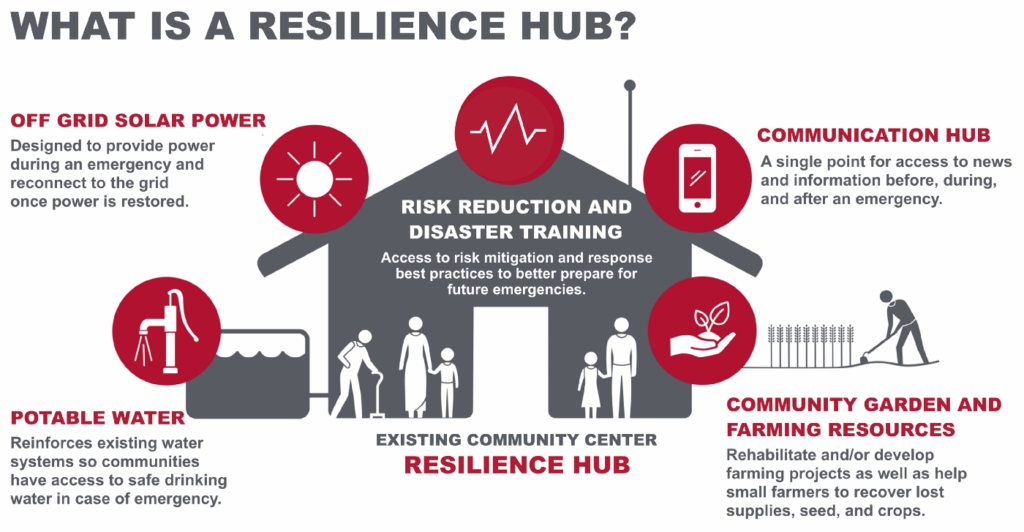
Resilience hubs are centers intended to help increase a community’s resilience.
The Mercy Corps standard of a resilience hub involves five key features: drinkable water, off-grid solar power, risk and disaster training, communication network, and community garden and farming resources (Mercy Corps, 2024).
Inspired by this definition, we propose the following criteria to define resilience hubs:
- A building or buildings located centrally or very near a local community in Puerto Rico where the public has access, potentially including some public land for gardening.
- A space that includes public facilities for the purpose of increasing disaster resilience, and in particular increasing access to food during those times.
- Examples of proposed facilities include but are not limited to:
- Community gardens or land
- Kitchen or canning facilities to help store food for disaster times
- Community emergency food pantries
- First aid kits
- Off-grid solar power, and communication technology
The phase one short term plan focuses on the availability and distribution of food and water sources under disaster circumstances. To achieve this, our proposal relies on a system of both large-scale resilience hubs located in densely populated regions such as San Juan, and numerous smaller ones scattered around the less populated regions.
We propose the installation of resilience hubs that function as community supermarkets with facets of disaster resiliency. The size of the population, the location, and population demographics of the surrounding area would further inform how large each hub and supermarket will be, elaborated here. We propose for local non-profit organizations, businesses, and municipalities to collaborate in setting up the systems and funding needed to run these hubs.
We propose changing the distribution of food first by expanding existing community supermarkets and initiatives to provide daily food access. If needed, new resilience hubs would be built in areas that don’t already have existing infrastructure. These resilience hubs should also have a component of disaster resiliency where communities can work to prepare for a disaster by packaging foods and distributing these before and after a disaster.
In the long-term, our proposal aims to focus on sustainability and growth in Puerto Rico’s local agricultural sector. By implementing community gardens and cooperatives, more food can be grown locally, reducing the cost of fresh produce and the distance it needs to travel. In addition, our proposal would aim to implement community education programs to teach individuals and communities about sustainable agriculture methods.
References
Mercy Corps. (n.d.). RESILIENCE HUBS; action and evidence. Retrieved October 30, 2025, from https://www.mercycorps.org/sites/default/files/2019-11/Mercy%20Corps%20Resilience%20Global%20Capacity%20Statement.pdf
Signal found: Mercy Corps & community WiFi. (2024, September 30). Mercy Corps. https://www.mercycorps.org/blog/signal-found-community-wifi
Ostolaza, C., Rosas, C., García-Blanco, A. M., Gittelsohn, J., & Colón-Ramos, U. (2021). Impact of the COVID-19 Pandemic on Food Insecurity in Puerto Rico. Journal of Hunger & Environmental Nutrition, 18(3), 1–16. https://doi.org/10.1080/19320248.2021.1997857
Terrascope. (n.d.). Terrascope | About. Terrascope | MIT. Retrieved November 10, 2025, from https://terrascope.mit.edu/overview/
Traylor, J. (2020, January 29). Signal found: Mercy Corps & community WiFi. Mercy Corps. Retrieved November 3, 2025, from https://www.mercycorps.org/blog/signal-found-community-wifi
U.S. Department of Agriculture. (2022). 2022 Census of Agriculture – Census Volume 1: 2023 Puerto Rico Island and Regional Data. USDA National Agricultural Statistics Service. Retrieved November 5, 2025, from https://www.nass.usda.gov/Publications/AgCensus/2022/Full_Report/Outlying_Areas/Puerto_Rico/
U.S. Department of Agriculture. (2025, January 8). Food Security in the U.S. – Key Statistics & Graphics | Economic Research Service. ERS.USDA.gov. Retrieved November 10, 2025, from https://www.ers.usda.gov/topics/food-nutrition-assistance/food-security-in-the-us/key-statistics-graphics#map
Background image: Gray, L. (2024). Picture of Toro Verde landscape in Puerto Rico [Photograph].